Kaia Ecklund has been on a meteoric rise since enrolling at Great Falls College.
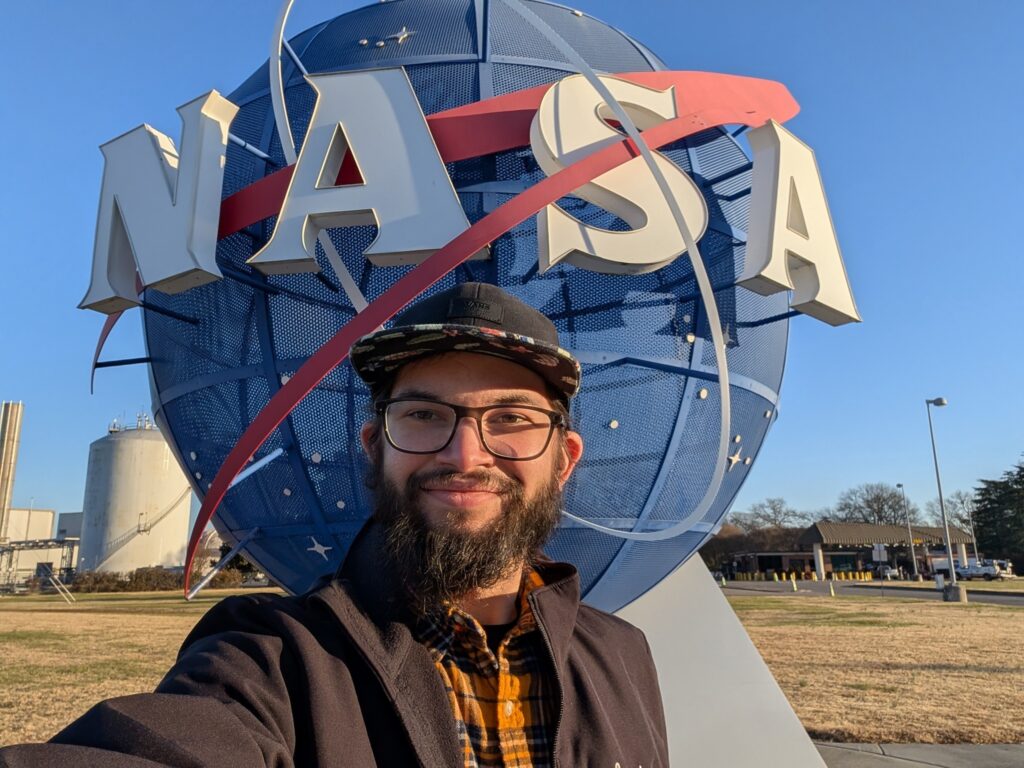
After graduating with an associate of applied science degree in cybersecurity on May 9, his journey is taking him to NASA’s campus in Langley, Virginia, where he will work this summer on the FireSense program that uses sensors to support wildfire research and safety.
When he put his application in for the NASA internship, Ecklund didn’t have high hopes.
“I figured it’d be a very competitive internship,” he said. “There are definitely people who have much more impressive résumés than I do.” He submitted his application, sent out a few backups, and tried not to think about it.
Then the message from NASA arrived.
“I had to reread the email like three times,” he said. “I was very excited. I think I smiled for three days straight.”
For someone who grew up fascinated by space and NASA, it felt surreal.
“Since I was a kid, I was always interested in space,” Ecklund said. “At some point I thought, ‘Oh, that’s probably not going to happen — you need to be an engineer or an astronaut.’ So the option to actually work there is going to be awesome.”
It’s been a wild ride for Ecklund, who started attending classes at Great Falls College in 2024 with the idea of just seeing how it went.
Answer: Pretty well.
Ecklund served as vice president of the Associated Students of Great Falls College and earned an internship last summer followed by an apprenticeship with the Autonomous Aerial System office at the University of Montana. The Montana Space Grant Consortium funded the internship that saw him working with drones in both his internship and apprenticeship.
At NASA, he will help design, prototype and install the next generation of sensor systems for bulldozers used in wildland fire suppression, improving temperature, wind and video-based situational awareness.
The project applies NASA’s safety culture and cross-disciplinary engineering expertise to create proactive tools that protect firefighters in high-risk environments. Working with the Alabama Forestry Commission, the team aims to give operators better real-time information so they can avoid dangerous burn-over situations and reduce reliance on emergency suppression systems.
“I’m really excited to learn more about programming sensors,” Ecklund said. “Working in like a prototyping environment is something I’m really excited for. That’s new to me. I’ve done small little
projects for fun, but being able to actually prototype something that may eventually be used is really cool … and getting to kind of see how an organization like NASA does those processes.”
Ecklund said there were too many possibilities to explore when he graduated from C.M. Russell High in 2021, so stepped back and waited for clarity before enrolling at Great Falls College.
“After finishing high school, I was interested in going to college, but I was unsure of what I wanted to study,” he said.
His path became clear after taking a few classes at Great Falls College despite his modest expectations.
“I decided that I would get my associate’s degree and at the very least gain an increased knowledge of computers for my own personal use,” he said.
Instead, he found momentum and a campus that lifted him up.
“There are some amazing support systems,” he said. “Everyone’s willing to help you figure out whatever you need help with.”
In addition to his role as vice president of the study body at Great Falls College, he serves on Curriculum Council and was elected vice president internal of the Montana Associated Students for the Montana University System. “There’s a lot of stuff to do, which is nice,” he said.
His instructors, he added, have been a major part of his trajectory.
“I think you get a great education at a two-year institution,” he said. “The only difference is cost. And a two-year college is way more affordable. Every instructor has been amazing here.”
That foundation at the college as well as the opportunities with the Autonomous Aerial System office at UM through the Montana Space Grant Consortium set the stage for the opportunity that would launch him to NASA.
Ecklund’s internship allowed him to learn drone operations, mapping techniques and research applications. He also earned his commercial drone pilot license.
The internship provided housing and pay, which made participation possible.
“Since this was a paid internship, I could go do the internship and not worry about the financial side of it,” Ecklund said.
Interns were encouraged to explore individual projects alongside group research. Ecklund gravitated toward developing technology to detect and identify drones.
“Drones are becoming way more prevalent,” he said. “If you have an event or something like that, you want to be able to detect whether a drone is coming in or not. It’s a security thing.”
He knew the project was ambitious for a single summer.
“It was kind of obvious early on that I wouldn’t get too far into the project… we had a lot of projects going on,” Ecklund said.
But his mentors saw promise and encouraged him to apply for an apprenticeship to continue the work, and that’s where his project truly took off.
Ecklund trained a computer-vision model capable of detecting drones entering a camera frame. Once detected, the system generates an HTML report and emails an image of the drone. It’s a low-cost, scalable approach to a growing security need.
Then came the moment that pushed his trajectory even higher.
Ecklund was selected to travel to NASA Langley Research Center.
“I was able to observe some of their current projects as well as learn some of what they use drones for in their research,” he said.
The experience was exhilarating and intimidating.
“There’s parts of me that are like kind of freaking out where I think I’m going to fail,” he said. But the work changed him. “It’s been a great experience. It’s nice to be able to use some of these technologies and have a research project that I never would have even thought about before this internship.”
More than anything, it gave him confidence.
“After this internship, I’m definitely more confident that I will be aiming for a tech-related job of some sort,” Ecklund said.
After the NASA internship, Ecklund will come back to Great Falls College for a semester to complete an associate of applied science degree in computer programming.
From there, the sky is the limit.
“I didn’t expect any of this to happen, so I’m trying to stay open and flexible and see where opportunities go,” Ecklund said. “A huge dream would be to work at NASA — that’d be amazing. The option to actually work there (this summer) is going to be awesome. I’m so excited.”
He also is open to the idea of returning to Great Falls to start his career.
“If I could find a computer-related job in Great Falls… it’s one of my favorite places I’ve ever been,” he said.