

GREAT FALLS — What began with a childhood fascination with her grandfather’s honey bees has helped take Great Falls College veterinary technology faculty member Dr. Cynthia Faux all the way to the publication of the second edition of a veterinary reference on honey bee health.
Faux is co-editor and an author of Honey Bee Medicine for the Veterinary Practitioner, Second Edition, recently published by Wiley. The book provides veterinarians and others involved in honey bee health with an evidence-based resource for diagnosing disease, managing colony health and treating honey bees.
It is a field that may surprise people outside veterinary medicine.
“I don’t think many people realize that veterinarians are involved with honey bee health,” Faux said. “Honey bees are now classified as livestock. They are a food-producing animal. Some of the medicine we give them for disease must be prescribed by veterinarians.”
That makes understanding honey bee health increasingly important for veterinarians and veterinary technicians, especially in an agricultural state such as Montana, one of the nation’s leading honey-producing states.
The importance extends far beyond honey, Faux said, adding that more than 30% of our food supply is pollinated by managed honey bee colonies, including everything from blueberries, apples and squash to crops such as alfalfa that help feed livestock.
“Honey bees are a critical part of today’s agriculture, and the threats to their health are enormous,” Faux said. “Veterinarians and veterinary technicians play a supporting role to the industry.”
Faux’s involvement with the book grew from another unusual part of her veterinary career: disaster response.
She met co-editor Terry Kane through their work as veterinarians with the federal National Disaster Medical System. The two were deployed together to 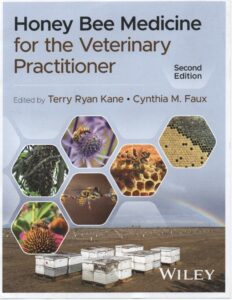 New Orleans following Hurricane Katrina. Years later, when Wiley approached Kane about creating the first edition of Honey Bee Medicine for the Veterinary Practitioner, Kane asked Faux to join the project.
“Disaster response prepares you in many ways for many things, even writing books,” Faux said.
The newly published second edition builds on the original with updated information and contributions from experts in apian medicine. New material includes a chapter placing veterinary honey bee practice in a global context and another focused on queen production failure, an increasingly important challenge in modern beekeeping.
Faux said creating the book involved much more than simply editing manuscripts. She and Kane determined topics, recruited chapter authors, reviewed multiple drafts, worked with authors on content, coordinated with Wiley, secured permissions for figures and illustrations, reviewed proofs and created the index.
The second edition contains significantly more than the 20% new material Wiley requires when considering a new edition, Faux said.
Long before she was editing books about honey bee medicine, Faux was learning about bees firsthand.
“My grandfather had bees, and I became interested at a young age,” she said. “I kept my own bees and learned from them.”
Faux sees a strong connection between the intellectual work required to produce a scholarly reference and what she does with Great Falls College students.
“This sort of scholarly activity uses the same intellectual tools I use for Great Falls College and teaching,” she said. “Is the information relevant, applicable to the audience, current and presented in a way that will resonate with the audience?”
While Faux jokes that writing books can be a “geeky, masochistic” undertaking, she said the motivation for taking on another edition is straightforward.
“I do it because I care a lot about the topic,” she said, before adding. “My family thinks it’s cool.”
And there may eventually be another edition. Faux and Kane could consider a third in about seven years.
“That’s just enough time to forget we said we’d never consider doing another edition,” Faux said.
Honey Bee Medicine for the Veterinary Practitioner, Second Edition is published by Wiley and is intended for veterinary practitioners, veterinary students, researchers in apian medicine and advanced beekeepers.